
.png)
Most companies running market research treat it like a data collection exercise. You build a list, gather info, organize it, review findings, then pass it to decision-makers. Three weeks later, by the time the insights reach someone’s desk, the market has already moved. How can the process be shortened? Analyze it to determine which tasks must be handled by humans and which can be delegated to AI agents. This will allow for faster progress while avoiding mistakes.

Let's return to example the market analysis process. Here's what actually happens in this workflow: someone spends 15 hours compiling competitor pricing. Another person builds a 40-slide presentation on customer sentiment. A 3rd review industry reports to spot trends. Each step feels productive, but none of it accelerates decisions.
The core issue isn't that market research is slow - it's that the work itself is fragmented. You have people doing research, people organizing data, people writing summaries, people reviewing the summaries. That's execution overhead. It doesn't create insight; it delays it.
What takes the most time
When the system tracks this process, you’ll see the same two bottlenecks recur:
1. Data consolidation eats time. You're pulling information from LinkedIn, company websites, industry databases, customer surveys, review platforms. Then you're translating it into a usable format—structured data, comparable metrics, relevant categories. That's rarely clean work.
This step can be almost entirely delegated to AI agents, which will gather all available information based on initial inputs while the employee focuses on more important tasks. All that remains is for you to check the result
2. The review cycle. Someone compiles findings, and someone else reviews them. They send it back for clarification or deeper research on specific competitors. This happens because raw findings aren't directly actionable - they need context, comparison, interpretation.
In this scenario, AI can provide an initial analysis based on input parameters and (potentially) internal databases; however, the context must be verified by a human, who should also make the final decision. In our system, this intermediate stage is called a "Review."
What do we see in the system as a result of the process assessment?
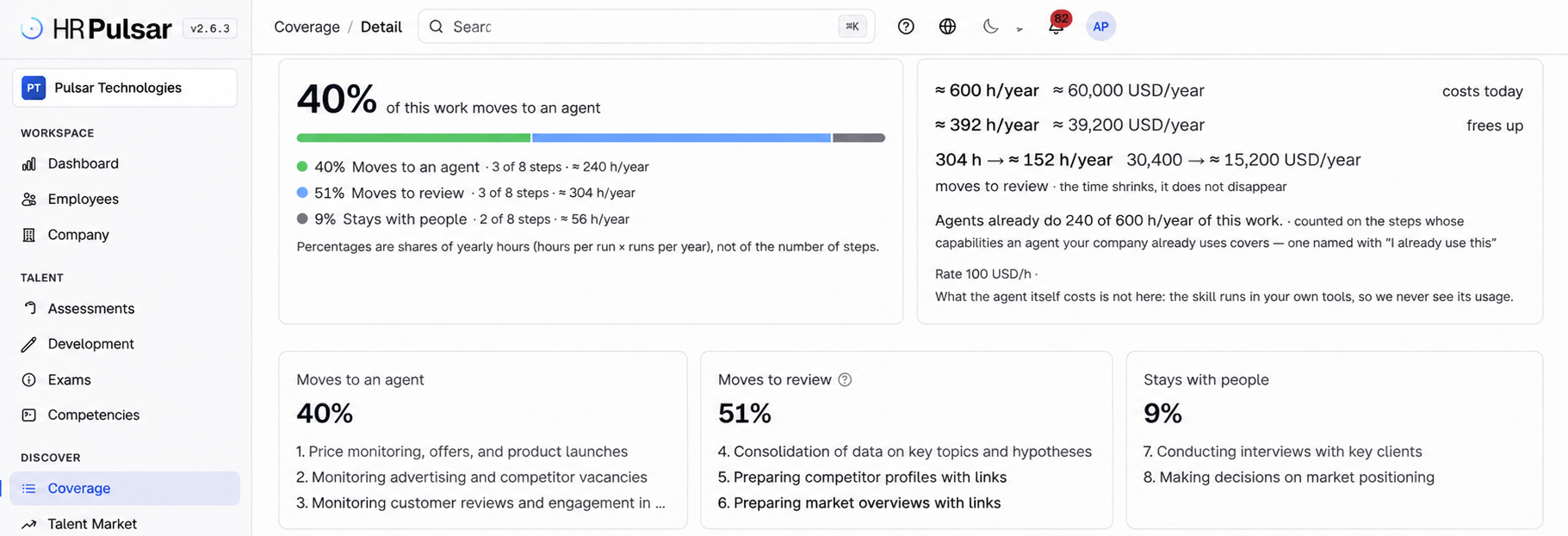
The process breaks down into three distinct phases.
- 40% of annual effort moves to agents - covering 3 of 8 steps (240 h/year), primarily monitoring competitor pricing, job postings, and customer reviews.
- 51% remains in review workflows - 3 of 8 steps (304 h/year), where data consolidation, competitive profiling, and market analysis synthesis review and approval by a human after a task has been processed by an AI agent.
- 9% stays with people entirely - 2 of 8 steps (56 h/year), reserved for direct customer interviews and strategic positioning decisions.
After optimization: potentially freeing up 392 hours in direct savings $39,2K per year.
Full breakdown of all 8 steps:
| Step | Who does it | Work type | | 1. Monitor competitor pricing | AI agent → human review | Agent runs, human reviews | | 2. Track job postings (hiring signals) | AI agent → human review | Agent runs, human reviews | | 3. Monitor customer reviews & feedback | AI agent → human review | Agent runs, human reviews | | 4. Consolidate market data | AI agent → human review | Agent structures, human validates | | 5. Profile competitors | AI agent → human review | Agent produces, human reviews | | 6. Synthesize market analysis | AI agent → human review | Agent analyzes, human contextualizes | | 7. Conduct customer interviews | Human only | Direct interaction & interpretation | | 8. Define strategic positioning | Human only | Strategic decision-making |

The critical insight: 304 hours move from execution to review. AI-agents already handle 240 of the 600 hours using existing capabilities in your infrastructure. The remaining potential comes from reassigning human time from data gathering and formatting to analysis and decision-making. It is worth noting that the final savings do not take into account the cost of additional tool investment.
Review cycles don’t disappear, but they compress. The agent produces structured findings; people validate and contextualize them. The intermediate assembly steps disappear from the everyday routine of real people.
*How are the time and savings calculated? Duration for solving 1 task × number of such tasks per year
Where automation changes the equation
Instead of collecting raw data first and organizing it later, an AI-agent pulls information and structures it against your predefined comparison framework.
In addition, this reduces review cycles. For ex. when an agent flags a competitor price change or identifies a pattern in customer feedback, the output comes pre-analyzed, and you don’t just get a bunch of raw statistics, a much more complete picture. The person reviewing can either approve it or dig deeper into specific aspects. You skip the "organize this for me" middle step entirely.
For a typical mid-market company doing quarterly market research, this cuts execution time by roughly 40-50%. This is consistent with a McKinsey study and a number of industry-specific case studies described in recent years. The gain comes primarily from automating assembly-line work, not from replacing strategic research judgment.
What doesn't go away
- Judgment calls don't disappear. An agent can flag that your biggest competitor just launched a new pricing tier. It can't tell you if it matters for your positioning or if you should respond. That's yours.
- Strategic interpretation remains human work. So does deciding which customer feedback signals matter versus which is noise. Agents are efficient at finding patterns. They're not good at weighting their importance to your business.
The practical picture
At the beginning of the article, we demonstrated the time savings achieved by redistributing responsibilities between AI and humans. In our example some of that capacity gets redirected to actually using the research rather than producing it. Some of it gets reinvested in research depth - more competitors analyzed, more customer segments tracked.
The real gain isn't the cost reduction. It's that your market research (or another business process that you want to automate) becomes a continuous input to strategy rather than a quarterly deliverable nobody reads completely.
How to evaluate this for your process
If this workflow sounds familiar, the question is whether the specific steps: data gathering, categorization, synthesis, review - are worth optimizing. That depends on how often you do this work and how time-sensitive your decisions are. For fast-moving markets or companies competing on first-mover advantage, faster research cycles compound. For stable markets with annual planning cycles, the gains are smaller, but with a cumulative effect (including in the context of future recruitment).
The only way to know is to map your actual process: steps, how much time each takes, who's involved, where bottlenecks sit. That's what HRPulsar's process assessment does - to show you exactly where automation makes sense for your specific operation. Most companies discover that their process has more automation potential than they expected. Usually because they've never actually measured it.
If you want to try out in practice how to automate your processes - you can check it on the free check in demo, no account needed. Try the demo